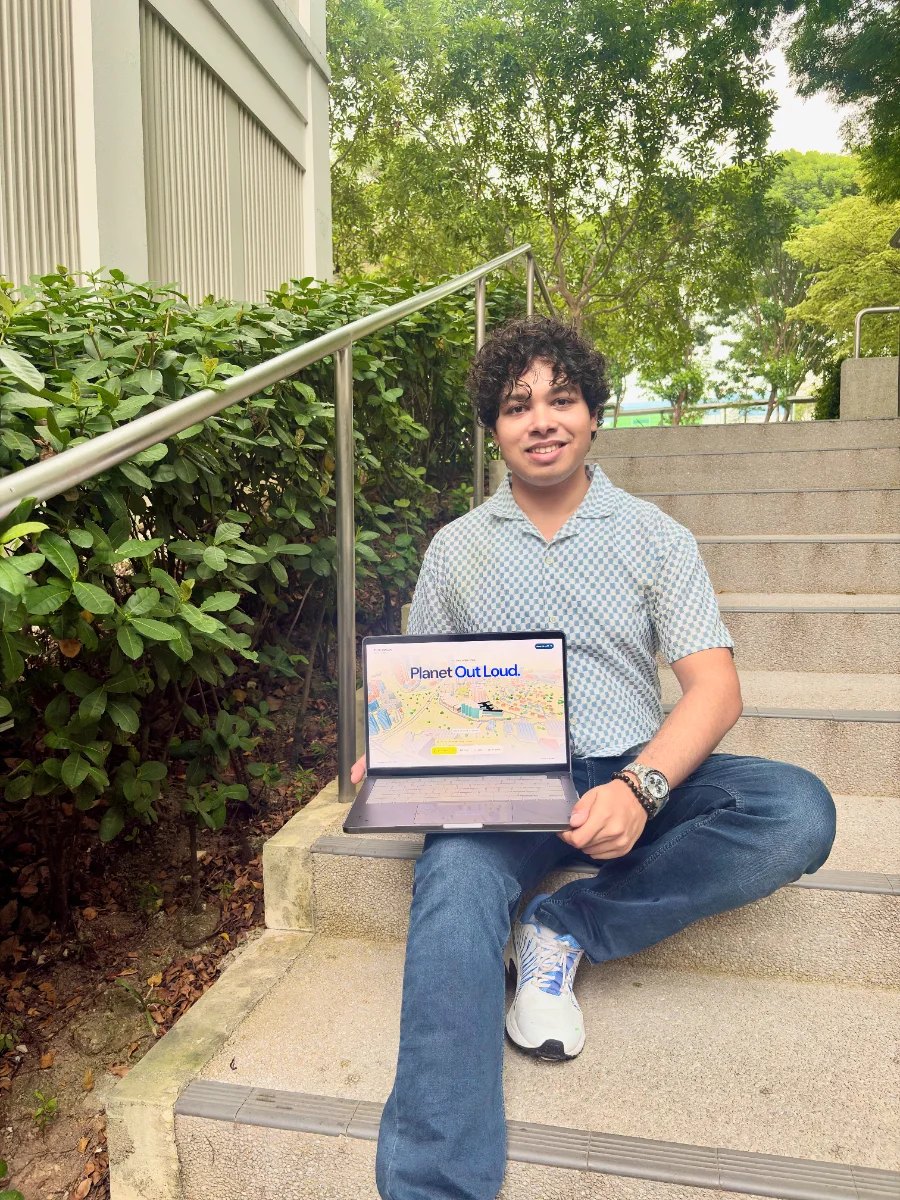
How it started
On 14 September 2026 my residential college sent an advisory: the PSI had crossed 100. I had been wondering about the air for weeks. At Oxford that summer I had taken Prof Ann Kelly’s course on anthropology and climate change. One line had stuck: nobody lives in a planetary average. People live on a street, breathing air they cannot choose. So I wondered whether a game could make a number feel that close.
What it shows
The panel shows three figures, each labelled with its source, its time and what it covers. They are the 24-hour PSI from NEA, the nearest AirGradient sensor’s PM2.5, and an hourly AQI by the US EPA NowCast method. It says when a feed is down. It does not claim street-by-street differences, because the data cannot support them. The campus is drawn in Three.js from OpenStreetMap footprints, with the landmarks adjusted by hand. The games are short. Ten claims to check. An island to see through a dry spell with six planning tokens. A glacier that melts by the GlaMBIE study’s numbers.
What happened next
NUS Computing wrote it up eleven days later, under the title From Haze to a Playable Campus. Then, from 5 October, the haze came for days on end, and the 24-hour PSI reached 230. The little panel was suddenly the news.
What changed my mind
A global dashboard would have been more complete. A campus people already knew was the one they could see.