Earthrise
On Christmas Eve 1968, while Apollo 8 was orbiting the Moon, astronaut Bill Anders looked away from the lunar surface he had been photographing and saw Earth instead, rising above the Moon’s horizon, blue and white against blackness. He took the picture anyway. Earthrise became an icon of the environmental movement and is often credited with helping inspire the first Earth Day sixteen months later (NASA, 2013). It marked a broader shift from protecting separate rivers, forests and landscapes to imagining Earth itself as one fragile, interconnected whole.
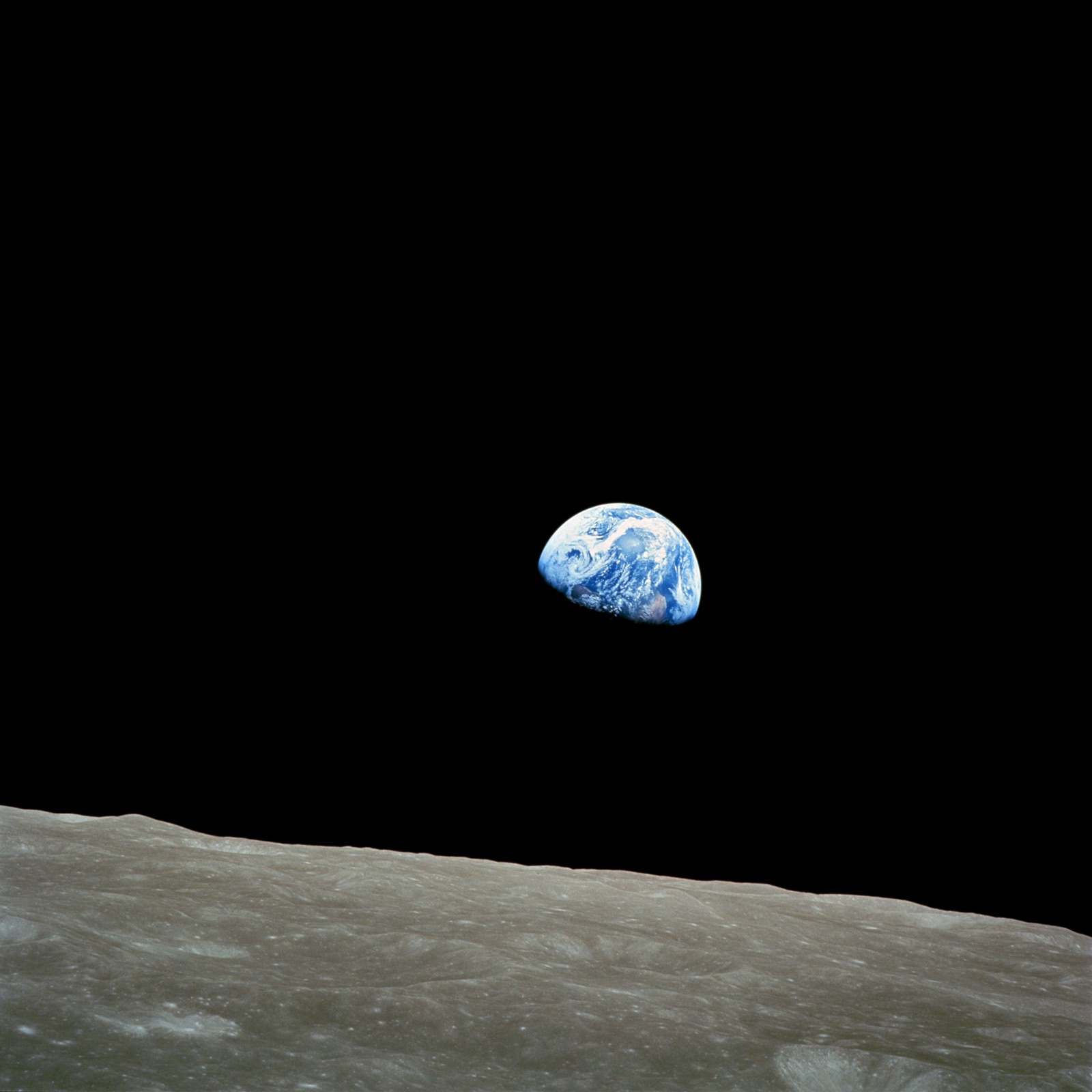
The story is usually told as a lesson about distance: you had to leave the Earth to see it whole, and seeing it whole is what taught us to love it. I want to notice what the photograph did at the same time, quietly, inside the same frame. By showing the Earth as one bounded object against a black field, it also produced the black field. It drew a line around the planet at the very moment it made the planet visible, so that the same image that gave new visual force to “the Earth” also made outer space newly vivid as its apparent opposite. This essay is about that line. My argument is that “the environment” is not a natural object with a natural edge. It is a cultural category, and its upper boundary, the altitude at which the world we feel responsible for is agreed to stop, was drawn by us and not by nature. That boundary does political work: it helps decide where environmental responsibility, regulation and accountability are allowed to stop. Orbit makes this boundary visible because it is a non-terrestrial domain densely filled with human infrastructure yet only partially incorporated into the environmental frameworks that assign stewardship and accountability.
Earthrise made “the world” newly imaginable as one bounded planet, but dependence has since pushed it beyond the ground. GPS, weather and disaster monitoring, financial timing and satellite internet all rely on orbit. By July 2026, more than sixteen thousand active satellites were in orbit, roughly two-thirds of them Starlink, with many more planned (McDowell, 2026; Barker et al., 2026). This growth is cultural, not geological. The essay therefore follows responsibility into a layer we occupy densely but still treat ambiguously as “environment,” asking why our moral geography stops where the atmosphere does not. Across the course, we have asked how events become crises (Fassin, 2021) and how doubt dresses itself as evidence. This essay asks how responsibility acquired an edge.
I. Inventing the Edge
Begin with the maneuver Earthrise performed, because anthropology’s first question about any category is who made it and how. Bruno Latour argued that modern politics is pulled toward what he calls the Global, the Earth grasped as a single distant object, seen as if from nowhere, available to be modelled, managed and protected as a whole (Latour, 2018). The Global is a real achievement; you cannot govern a climate you cannot picture as one system. But it is a view from a great height, and a view from a height always has an outside. The planet-as-whole and the void around it are produced together, in the same look. To see the Earth as the Global is already to have decided where it ends.
Our institutions crossed that edge before our imagination did. After years inside NASA’s life-science and engineering programmes, Valerie Olson found that American institutions already treat outer space as an environmental system to be monitored, modelled and managed for the survival of humans and machines, a form of “ecobiopolitics” (Olson, 2018). Public environmental imagination still treats it as Earthrise’s empty backdrop. The boundary holds not because the world stops there, but because we have agreed to stop looking.
Recent calls for “space environmentalism” have already challenged the assumption that environmental concern stops at the atmosphere, proposing that orbital space be treated as an ecosystem requiring care and regulation (Lawrence et al., 2022). This essay begins from that intervention but asks a different question. The problem is not only whether orbit possesses ecosystem-like characteristics. It is how orbit became institutionally legible as a technical operating environment while remaining comparatively illegible as a domain of public environmental responsibility. The distinction matters because naming something an operating environment may invite monitoring for the protection of satellites, whereas naming it an environmental commons invites questions about standing, unequal access and obligations to those affected by its use. The anthropological problem is therefore not merely to enlarge an existing environmental category, but to examine why one meaning of “environment” became administratively powerful while another remained politically weak.
One objection follows immediately. If material dependence and cross-boundary effects are enough to make something an environment, the category threatens to expand until it means little, since almost everything is connected to almost everything else. Thinking in terms familiar from systems engineering, my claim concerns where the system boundary is drawn. I am not arguing that everything is environment. I am arguing that orbit cannot be consistently excluded from it, because the criteria we already use to include the atmosphere, material dependence, cumulative harm and effects that cross the boundary, apply to orbit as squarely as they do to the air.
Yet the boundary itself proves surprisingly difficult to locate. The atmosphere thins by degrees rather than ending, and even the legal edge of space remains disputed between agencies, set at eighty kilometres by some and a hundred by others (McDowell, 2018). No single physical process supplies the sharp edge our institutions seem to require. The boundaries that law, commerce and governance rely upon are therefore not discovered but produced.
II. Holding the Edge
A category with no natural basis has to be actively maintained, and the oldest tool for maintaining this one is a single word: empty. Colonial law called inhabited land terra nullius, nobody’s land, before it could be claimed, and Wolfe shows the logic that follows: settler colonialism is a land-centered structure organized around eliminating Indigenous presence and establishing a replacement society (Wolfe, 2006). Orbit is increasingly narrated through a related register. It is described as a vacuum, nobody’s, and then it is filled, and the filling quietly becomes the only property claim that exists. Although orbital positions and spectrum are internationally coordinated, prior filings, technological capacity and physical occupation can produce powerful first-mover advantages and constrain later users.
The law supplies the alibi. The 1967 Outer Space Treaty forbids national appropriation, which sounds like the opposite of enclosure. In practice, orbit has been read as Hardin’s commons, a resource the first arrivals can turn to lasting advantage (Hardin, 1968). But this course taught me to distrust Hardin on his own terms. McCabe’s Turkana case shows that an apparently ungoverned commons may contain situated rules outsiders fail to see (McCabe, 1990). Orbit too is governed, quietly, through bodies such as the International Telecommunication Union, and that quiet is a convenient form of governance, not its absence. Orbit is therefore not an ungoverned commons but a highly regulated one whose rules distribute access unevenly. The 1979 Moon Agreement declared the Moon and its natural resources the “common heritage of mankind,” but attracted fewer than twenty parties. The 2020 Artemis Accords preserve the formal ban while treating resource extraction and utilization as compatible with non-appropriation and permitting temporary “safety zones.” Critics may therefore see appropriation being functionally redefined: not as sovereignty over territory, but as exclusive control over resources and sites that can be reached, extracted or occupied, a terra-nullius-like logic in another register, not identical to territorial dispossession, but similarly dependent on describing a domain as empty before making exclusive use appear legitimate.
Indigenous scholars have named the continuity most directly. Neilson and Ćirković argue that commercial space exploration can reproduce colonial relations and ask how outer-space law intersects with Indigenous treaty rights (Neilson and Ćirković, 2021). Governance has nevertheless split a sky that some Indigenous legal orders and cosmologies never divided into separate jurisdictions, airspace, outer space, telecommunications, astronomy and defense, each with its own regulator and none positioned to hear a claim about the sky as a whole.
The manufacture of emptiness is not only rhetorical; it has a history on the ground. Peter Redfield shows how the space center at Kourou inherits a colonial geography of remoteness previously central to French Guiana’s penal colony (Redfield, 2000). Alice Gorman similarly traces how launch ranges at Woomera and Hammaguir were imposed across inhabited Aboriginal and Tuareg landscapes (Gorman, 2019). The rhetoric of an empty sky and the clearing of inhabited ground for the infrastructure that reaches it are one story told at two altitudes.
It is worth asking, as anthropology always does, whom the emptiness serves. The parties filling orbit, a handful of telecommunications firms, launch providers, militaries and the states behind them, benefit from regulatory fragmentation that limits environmental accounting, public standing and opportunities to object. The classification does not neutrally describe altitude; it distributes who gets to use the sky and who has to answer for it, and at present it disproportionately concentrates the first among a few while dispersing the second across institutions.
The consequence is material: a boundary can externalize harm! Moving an activity beyond what we call “the environment” does not remove its effects, only the obligations attached to them; relocation begins to look like resolution. Space tourism reproduces this edge. When Blue Origin flew Katy Perry above the Kármán line in April 2025, the value lay in crossing a boundary the industry had drawn, branded and certified (Blue Origin, 2025). The commodity was not altitude but classification. Bezos’s proposal to move heavy, polluting industry off Earth makes the stakes clearer still (Boyle, 2018). Relocation counts as environmental progress only if nothing is owed to the receiving place. The harder question is not where the environment ends, but why responsibility should end there. “Away” may exist as distance; it should not exist as exemption.
There is a final irony that makes the boundary hardest to defend. The infrastructure we only partially govern as environment is also the infrastructure that produces “the environment” as a knowable thing in the first place. Much of the evidence through which Earth becomes knowable as a single environmental object, sea level, ice mass, deforestation, wildfire, methane and sea-surface temperature, is gathered from orbit. The course’s treatment of expertise pressed the question of who gets to speak as science (Meyer, 2024); orbit sharpens it into who gets to author “the Earth” as a knowable object, and what that authorship leaves out of the object it makes. Walker-Crawford shows how climate evidence is mediated by relations of trust between those who produce it and those who receive it (Walker-Crawford, 2023), while Callison shows that facts come to matter through the communities that carry them (Callison, 2014). Orbit is where that evidence is now physically made, by parties whose orbital activities are not subject to environmental accounting comparable to that which their own instruments make possible below.
The one layer that lets us see the Earth as an environment became the very layer we declared was not part of it!
A phone communicating with a satellite makes Berlant’s account of the commons as infrastructure tangible: navigation, forecasting, shipping and disaster response depend upon hardware that most users cannot see or name (Berlant, 2016). This infrastructure is common not because it belongs equally to everyone, but because collective life has become dependent upon it. Wakkary’s more-than-human design extends that dependence across the satellite’s entire material life: mineral extraction, manufacture, launch, orbital operation, collision, controlled re-entry and atmospheric residue (Wakkary, 2021). Seen across that sequence, the satellite cannot be isolated from an environment merely because different institutions govern each altitude through which it moves.
My own training initially taught me to see a satellite as a node in a system: an engineered object defined by its function, its links to other nodes and the reliability of the services it provides. From that perspective, the system boundary seems obvious. The satellite begins at manufacture, performs its task in orbit and ends at decommissioning. This course unsettled that boundary. Once extraction, launch sites, atmospheric emissions, orbital congestion and re-entry residues are included, what looked like a self-contained technical system becomes a social and environmental relation. The engineering question is whether the satellite works. The anthropological question is who gets to decide what counts as part of the system when its costs are calculated. Had I not taken this course, I doubt I would have learned to ask that question as an anthropologist or seen how closely and unexpectedly human and natural systems are entangled in ways we rarely notice.
III. Crossing the Edge
A boundary this useful can hold for a long time, but it cannot hold against physics, and this is where the physics crosses back. The boundary becomes material when we ask what counts as pollution. Mary Douglas argued that dirt is not a property of a substance but “matter out of place,” a violation of a classification rather than a thing in itself (Douglas, 1966). A bottle in a river is easy to place this way; it sits there, visibly, and you can point to it. Orbital debris does none of that. It moves at seven or eight kilometres a second, fast enough that a fleck of paint can crack a window, and, depending on altitude, it may persist for years or centuries, while collisions can multiply it into hundreds of additional fragments, a runaway named Kessler syndrome (Kessler and Cour-Palais, 1978) that is Hardin’s tragedy rewritten as orbital mechanics. Rob Nixon called this kind of harm “slow violence,” damage so gradual and dispersed that it never yields the single image a movement can rally around, and therefore struggles to register as harm at all (Nixon, 2011). Reentry pollution may be the purest case of it, because it does not even leave a body on the ground to eventually photograph. Picture a satellite reaching the end of its five-year life and burning up on reentry exactly as planned. Nothing lands. No one sees it. No animal dies, no coast erodes, no headline runs. Has environmental harm occurred? If your first instinct is no, because nothing visible happened, that instinct is the whole subject of this essay. If your instinct is yes, you have just extended “the environment” past the point where you can see, feel or narrate the damage, which is precisely the extension we already make for reefs and glaciers, and a move that remains marginal to mainstream environmental law and public environmental imagination, despite a growing literature on space environmentalism.
The material process behind the second instinct is no longer merely speculative, although its ultimate atmospheric consequences remain uncertain. In 2024 a team led by José Ferreira at the University of Southern California published an atomic-scale molecular-dynamics model of what happens to a satellite’s aluminium body as it burns up (Ferreira et al., 2024). It does not vanish. It oxidizes into fine nanoparticles that form in the mesosphere and may persist in the atmosphere for decades. As they descend into the stratosphere, where most atmospheric ozone is concentrated, the model suggests that aluminium-oxide particles could provide surfaces for chlorine activation and may therefore interfere with the ozone layer, whose protection under the 1987 Montreal Protocol became a landmark of coordinated global action. The team estimated that satellite re-entries in 2022 increased aluminium influx into the upper atmosphere by 29.5 per cent above natural levels and generated about seventeen metric tons of aluminium oxides. Mega constellation scenarios could raise aluminium-oxide production above 360 metric tons per year. The regulatory problem addressed by the Montreal Protocol largely followed a one-way arrow: chemicals released near the ground rose into an atmosphere that needed protection from what we sent upwards. Re-entry reverses that arrow. Material now falls out of orbit and into the atmosphere across a boundary the treaty was not designed to govern, because in 1987 the volume and planned regularity of satellite demise were far smaller and mega constellations had not been contemplated.
A second study sharpens the picture. Barker and colleagues modelled a decade of launch and re-entry emissions and found that the climate effect is driven mainly by black carbon from rocket exhaust, while projected global stratospheric ozone depletion remains small. They describe these activities as a “small-scale, uncontrolled, unvetted, and untested solar geoengineering experiment” (Barker et al., 2026). The studies do not establish that mega constellations will cause catastrophic ozone loss. They identify different and still uncertain pathways, aluminium particles from re-entry and black carbon from launches, that are introducing new material into the upper atmosphere without a settled international system for assessing their cumulative effects. This recalls the course’s analysis of framing: vocabulary helps determine whether a thing becomes governable at all.
Step back and a pattern appears that is larger than orbit. A recurring pattern in modern environmentalism has been the enlargement of what counted as “the environment.” Rachel Carson enlarged it to include pesticides moving through food chains (Carson, 1962); the ozone scientists enlarged it to the stratosphere; climate science enlarged it again to an invisible chemistry of the whole atmosphere. Each required taking seriously processes that were difficult to perceive directly, and each exposed the arbitrariness of an earlier boundary. Gibbard and colleagues argue that the Anthropocene is best understood as an ongoing event rather than a dated epoch, precisely because human impact never had one clean boundary in time (Gibbard et al., 2022). It has none in altitude either. Aluminium oxide and chlorine activation do not cease to be environmental processes requiring scrutiny merely because the material originated in orbit. One reason the line holds is that its damage has not yet acquired an image comparable to Earthrise.
From the opening lectures, the course unsettled boundaries between human and animal, nature and culture, life and non-life; across expertise, commons, toxicity, design and colonialism, it asked who draws categories, whose knowledge sustains them and whom they serve. Orbit gathers those questions around their shared container: the world within which such distinctions are allowed to matter. Somewhere above a hundred kilometres that container is assumed to stop, and above it the same acts change their names. Pollution becomes engineering. A commons becomes an orbital slot. An emptied sky becomes connectivity. A continuation of the land that some Indigenous cosmologies have read for centuries becomes, the moment it is filed under sky rather than land, available for forms of appropriation we already recognize on the ground. Nature drew none of those lines. The aluminium-oxide particle drifting down from a burned satellite does not know the boundary is there. We drew it.
We searched for the Earth’s edge in the atmosphere and finally in law. Every natural candidate dissolved into a gradient. The only sharp boundary that remained was the one we had drawn ourselves. Nature offered continuity; governance required categories. Perhaps the reason the boundary endured for so long is precisely because orbit became infrastructure before it became an experience. We came to depend on it long before we learned to imagine it.
We usually tell environmental history as a series of discoveries about nature. This essay has suggested it is at least as much a series of discoveries about ourselves, each one the admission that a boundary we had believed was natural was one we had drawn. If orbit eventually takes its place beside the forest, the ocean, the glacier and the atmosphere inside the category of “the environment,” it will not be because nature changed. It will be because our idea of where the Earth ends finally caught up with the world that was there all along. And with that enlargement comes the harder recognition: responsibility cannot stop simply because we have given the place beyond the boundary another name.
“We came all this way to explore the Moon, and the most important thing is that we discovered the Earth.”
— William Anders, reflecting on Apollo 8 (quoted in NASA, 2024)
Bibliography
- Anders, W. (1968) Earthrise [photograph]. NASA, Apollo 8, 24 December 1968. NASA image AS08-14-2383.
- Artemis Accords (2020) Principles for Cooperation in the Civil Exploration and Use of the Moon, Mars, Comets, and Asteroids. Washington, DC: NASA.
- Barker, C.R., Marais, E.A., et al. (2026) “Radiative Forcing and Ozone Depletion of a Decade of Satellite Megaconstellation Missions.” Earth’s Future, 14, e2025EF007229. DOI: 10.1029/2025EF007229.
- Berlant, L. (2016) “The Commons: Infrastructures for Troubling Times.” Environment and Planning D: Society and Space, 34(3), pp. 393–419.
- Blue Origin (2025) New Shepard NS-31 Mission. Available at: https://www.blueorigin.com/news/new-shepard-ns-31-mission
- Boyle, A. (2018) ‘Jeff Bezos: “We will have to leave this planet” … but how and why?’ GeekWire, 29 May. Available at: https://www.geekwire.com/2018/jeff-bezos-isdc-space-vision/
- Callison, C. (2014) How Climate Change Comes to Matter: The Communal Life of Facts. Durham: Duke University Press.
- Carson, R. (1962) Silent Spring. Boston: Houghton Mifflin.
- Douglas, M. (1966) Purity and Danger: An Analysis of Concepts of Pollution and Taboo. London: Routledge.
- Fassin, D. (2021) “Crisis.” In Das, V. and Fassin, D. (eds) Words and Worlds: A Lexicon for Dark Times. Durham: Duke University Press.
- Ferreira, J.P., Huang, Z., Nomura, K.-i. and Wang, J. (2024) “Potential Ozone Depletion From Satellite Demise During Atmospheric Reentry in the Era of Mega-Constellations.” Geophysical Research Letters, 51, e2024GL109280. DOI: 10.1029/2024GL109280.
- Gibbard, P. et al. (2022) “The Anthropocene as an Event, Not an Epoch.” Journal of Quaternary Science, 37(3), pp. 395–399.
- Gorman, A. (2019) Dr Space Junk vs the Universe: Archaeology and the Future. Cambridge, MA: MIT Press.
- Hardin, G. (1968) “The Tragedy of the Commons.” Science, 162(3859), pp. 1243–1248.
- Kessler, D.J. and Cour-Palais, B.G. (1978) “Collision Frequency of Artificial Satellites: The Creation of a Debris Belt.” Journal of Geophysical Research, 83(A6), pp. 2637–2646.
- Latour, B. (2018) Down to Earth: Politics in the New Climatic Regime. Cambridge: Polity Press.
- Lawrence, A. et al. (2022) “The Case for Space Environmentalism.” Nature Astronomy, 6, pp. 428–435. DOI: 10.1038/s41550-022-01655-6.
- McCabe, J.T. (1990) “Turkana Pastoralism: A Case Against the Tragedy of the Commons.” Human Ecology, 18(1), pp. 81–104.
- McDowell, J.C. (2018) “The Edge of Space: Revisiting the Kármán Line.” Acta Astronautica, 151, pp. 668–677.
- McDowell, J.C. (2026) Space Statistics: Active Payloads. Jonathan’s Space Report. Available at: https://planet4589.org/space/stats/active.html
- Meyer, J.M. (2024) “Power and Truth in Science-Related Populism.” Political Studies, 72(3), pp. 845–861.
- NASA (2013) “NASA Releases New Earthrise Simulation Video.” NASA, 20 December.
- NASA (2024) “NASA Administrator Remembers Apollo Astronaut William Anders.” NASA, 8 June. https://www.nasa.gov/news-release/nasa-administrator-remembers-apollo-astronaut-williams-anders/
- Neilson, H. and Ćirković, E.E. (2021) “Indigenous Rights, Peoples, and Space Exploration: A Response to the Canadian Space Agency Consulting Canadians on a Framework for Future Space Exploration Activities.” arXiv preprint arXiv:2104.07118.
- Nixon, R. (2011) Slow Violence and the Environmentalism of the Poor. Cambridge, MA: Harvard University Press.
- Olson, V. (2018) Into the Extreme: U.S. Environmental Systems and Politics beyond Earth. Minneapolis: University of Minnesota Press.
- Redfield, P. (2000) Space in the Tropics: From Convicts to Rockets in French Guiana. Berkeley: University of California Press.
- United Nations (1967) Treaty on Principles Governing the Activities of States in the Exploration and Use of Outer Space (Outer Space Treaty).
- United Nations (1979) Agreement Governing the Activities of States on the Moon and Other Celestial Bodies (Moon Agreement).
- United Nations Environment Programme (1987) Montreal Protocol on Substances that Deplete the Ozone Layer. Nairobi: UNEP.
- Wakkary, R. (2021) Things We Could Design: For More Than Human-Centered Worlds. Cambridge, MA: MIT Press.
- Walker-Crawford, N. (2023) “Climate Change in the Courtroom: An Anthropology of Neighborly Relations.” Anthropological Theory, 23(1), pp. 76–99.
- Wolfe, P. (2006) “Settler Colonialism and the Elimination of the Native.” Journal of Genocide Research, 8(4), pp. 387–409.
Written for Prof Ann Kelly’s course on anthropology and climate change at Exeter College, Oxford, during the Exeter College Summer Programme 2026.
More on climate: the climate page.