“...the Loss lighteth rather easily upon many than heavily upon few, and rather upon them that adventure not than those that do adventure.”
An Act concerning Matters of Assurances amongst Merchants, 1601
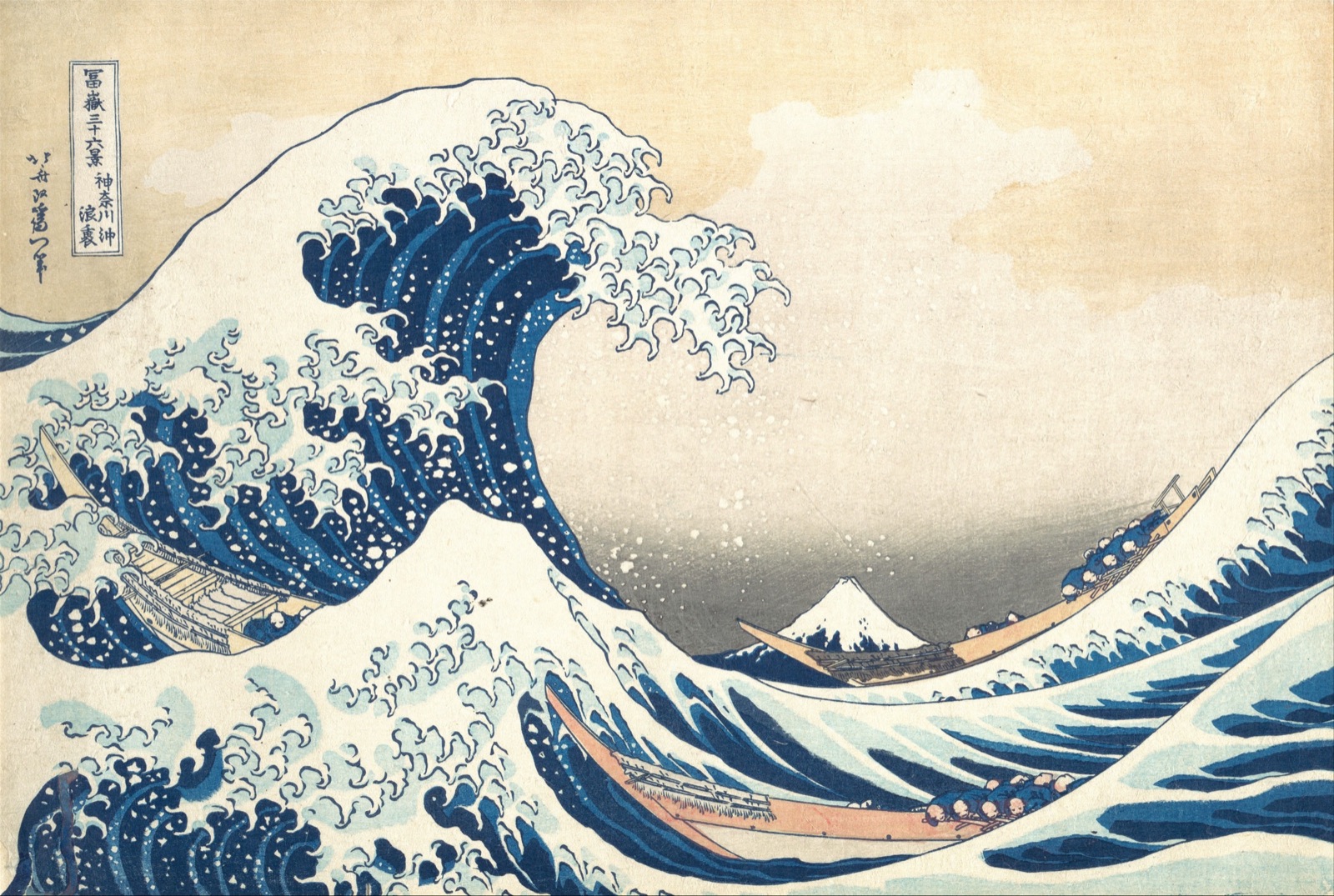
A ship that never returned
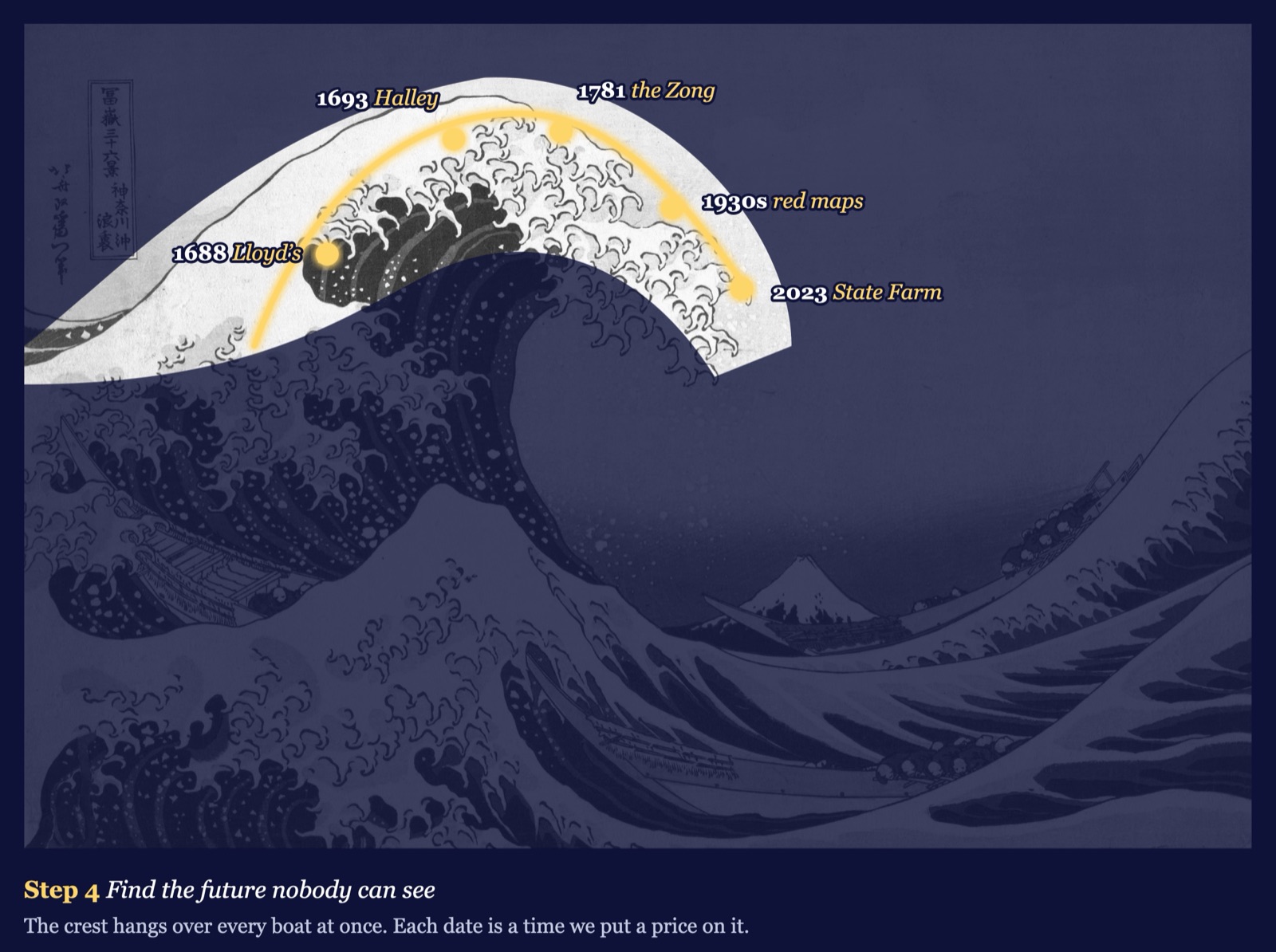
In the late seventeenth century, a man named Edward Lloyd kept a coffeehouse in London, and in 1688 a notice in the London Gazette offering a reward for some stolen watches told readers to bring news to “Edward Lloyd’s coffee house” (Lloyd’s, n.d.). The people who gathered there cared about ships. Captains brought news of voyages, merchants talked about cargoes arriving from overseas, and men with money decided which voyages they were willing to insure. The coffeehouse would eventually give its name to one of the most important insurance markets in the world.
What interests me is what was actually being sold over those coffee cups. A merchant sending a ship across the Atlantic knew it might never come back: a storm, a fire or a reef could take the vessel and everything in it. He could carry that loss himself, or pay someone else to carry part of it. If the ship came home safely, the underwriter kept the premium and the merchant received nothing. He had still not wasted his money. What he had bought was the ability to send the ship at all. Parliament had said as much in 1601, in an Act setting up a court for insurance disputes: because of policies of assurance, the loss of a ship no longer meant the undoing of any man, “whereby all Merchants, especially of the younger sort, are alured to venture more willingly and more freely” (Policies of Assurance Act, 1601). How much trade insurance actually created is harder to know. In its early days many English merchants still sailed uninsured, or only partly covered, for all but the riskiest voyages, and insurance became ordinary only after London premiums fell by more than half during the seventeenth century (Leonard, n.d.). But the Act names the thing this essay is about. The most valuable thing the contract produced never appeared in anyone’s accounts: a voyage that happened because a merchant was no longer too afraid to make it.
I came to this question from an earlier essay of mine, on a climate-denial film, where I noticed that the Montreal Protocol had worked so well that it wiped out its own evidence. Nobody remembers the ruined ozone layer it prevented, because that sky never arrived. I assumed the difficulty with futures that never happen was simply that they leave nothing to see. Lloyd’s suggests something stranger. A price put on a future that may never happen does not wait for that future. It changes what people do now. This essay follows that idea from a London coffeehouse to the algorithms now deciding which homes in California can be insured, and asks how societies learned to put prices on futures nobody can observe, and what happens when those prices begin to shape the futures they were meant only to describe.
I. Learning to Count the Future
Before a future can be priced, it has to stop belonging to a single person. For most of history a shipwreck, a fever or a fire was a matter of fate, providence or bad luck. That began to change in 1662, when John Graunt, a London haberdasher, worked through the city’s weekly Bills of Mortality and noticed that deaths, which looked chaotic one at a time, fell into steady proportions when counted in thousands (Graunt, 1662).
There is something slightly odd about where the story goes next: from a London coffeehouse to an astronomer reading death records in a city more than a thousand kilometres away. In 1693 Edmond Halley, whom most of us remember for a comet, was studying the births and burials recorded in Breslau, which the pastor Caspar Neumann had compiled and sent to the Royal Society. He wanted to know what an annuity ought to cost, which meant first working out how long the person receiving it was likely to live. Nobody knew, of course. A person could die tomorrow or live another forty years, and Halley had no more access to that particular future than the merchant at Lloyd’s had to the weather waiting for his ship. What Halley saw was that he did not need it. He needed to know how many people of a given age were still alive a year later, or five, or ten, and that number turned out to be remarkably regular (Halley, 1693).
I like that the solution required him to stop asking about the person whose life he was pricing. The table worked because it described thousands of lives and none in particular. Ian Hacking calls the long result of this “the taming of chance”: over the next two centuries, governments and companies learned to treat what is unpredictable for one person as predictable across many (Hacking, 1990). It also hides the trick that makes insurance possible. The uncertainty that makes a death frightening to one family is exactly what lets many families share its cost.
The numbers were not enough on their own. Viviana Zelizer found that in nineteenth-century America many people regarded life insurance with real suspicion, because paying money in anticipation of a death felt uncomfortably close to betting on it (Zelizer, 1979). Religious leaders condemned it as a sacrilegious gamble on human life. Over the following decades the same purchase was slowly recast as a duty: a husband who insured his life was no longer gambling on his death, he was providing for his family. The contract had hardly changed. What it meant to buy one had. Mathematics made the transaction calculable; it took a change in morals to make it respectable.
The unease Zelizer describes had a darker precedent in Lloyd’s own trade. Much of the marine insurance written in eighteenth-century London covered the slave economy; Lloyd’s own historical research describes it as one of the major markets for British marine insurance (Draper, n.d.). In 1781 the crew of the slave ship Zong, short of water and with many captives sick, threw more than 130 enslaved Africans into the sea. The owners then claimed for them from their insurers as lost cargo, and the dispute reached court as Gregson v Gilbert (1783). The historian James Walvin called it “mass murder masquerading as an insurance claim” (Walvin, 2011). The insurers refused to pay. The owners won before a jury, but Lord Mansfield ordered a new trial once evidence emerged that the crew had misjudged their position near Jamaica and that rain had fallen before the last killings, and there is no record that the retrial took place or that the claim was ever paid. What unsettles me is the question the court was asked. It was not whether more than a hundred people had been murdered, but whether their deaths were a loss the insurers had to cover. An insurance calculation can be correct while the world it makes possible is not, and reducing one party’s risk says nothing about whose suffering made the voyage profitable. A system for pricing the future can also decide, without ever saying so, whose futures it is able to see.
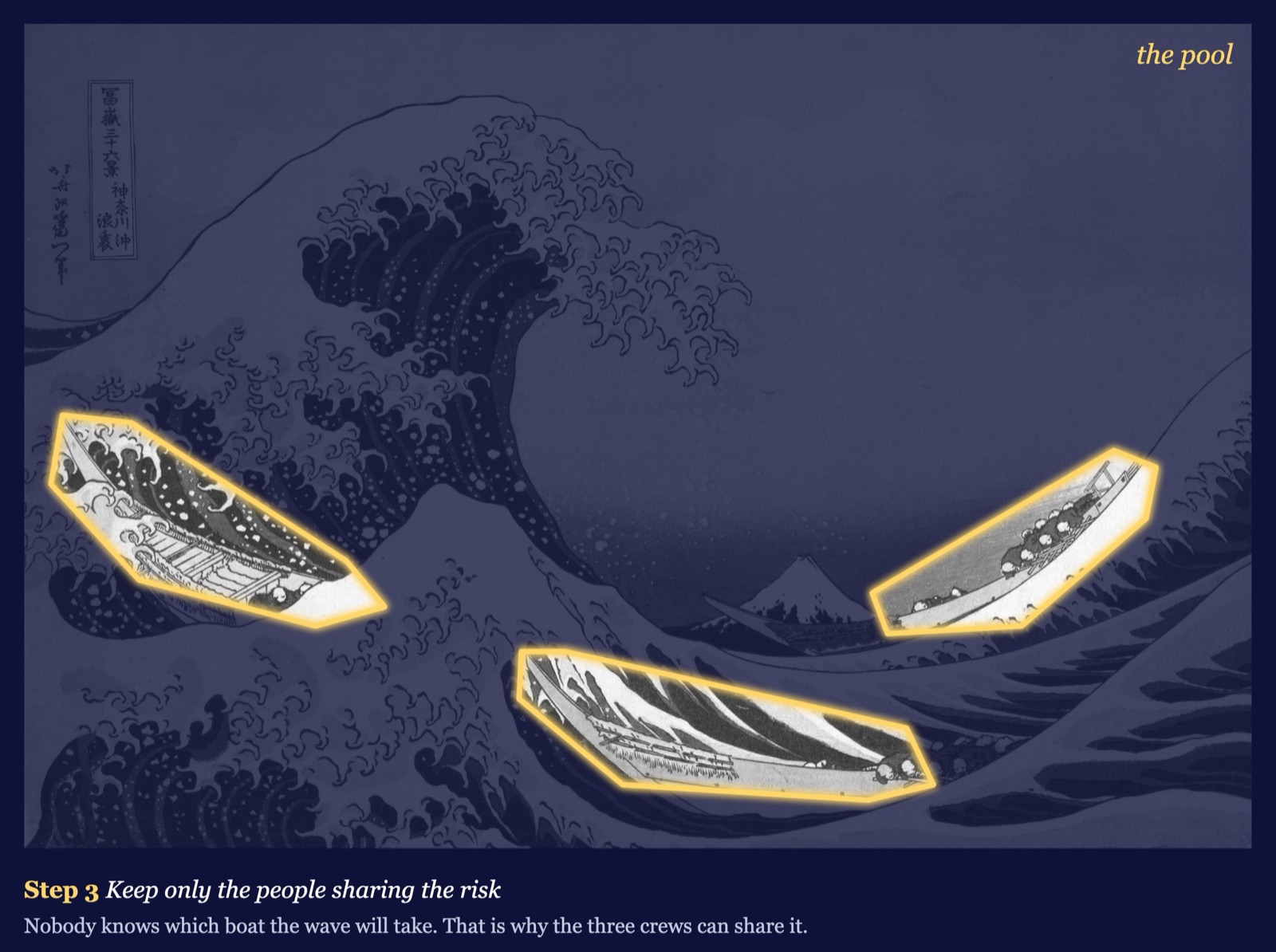
What these institutions actually sell is easy to misdescribe. Imagine a factory with a 2% chance each year of a fire that would cause $10 million of damage, an expected loss of $200,000 a year. A sprinkler system that lowers the chance to 0.5% is worth about $150,000 a year in damage avoided. If the factory then goes a year without a fire, it has learned almost nothing, because there was a 98% chance it would have been fine anyway; a broken sprinkler would have produced the same quiet year. Paul Holland called this “the fundamental problem of causal inference”: we only ever see one of the two worlds we are comparing (Holland, 1986). Insurance answers the problem by never claiming to know which world you are in. It spreads the cost of losses across many people whose individual futures stay unknown, and Kenneth Arrow showed why that is worth paying for: a household can rationally prefer a certain small premium to a small chance of ruin (Arrow, 1963).
There is one word in that explanation that will matter later. Insurance works because nobody knows who.
II. Pricing the Future
A price on a future is usually treated as a measurement. The sociologist Donald MacKenzie argued that in finance it often works more like a machine. When Fischer Black and Myron Scholes published their formula for pricing options in 1973, real option prices did not fit it well. As traders adopted it, prices moved towards the formula until theory and market agreed closely; then, after the crash of October 1987, the agreement broke down for good, leaving a lasting gap between model and market that traders call the volatility skew (MacKenzie and Millo, 2003; MacKenzie, 2006). MacKenzie’s title for his book says it best: the model was “an engine, not a camera” (MacKenzie, 2006). A camera records a world that exists without it. An engine changes the world by running.
The most consequential engine of this kind in American history was drawn in coloured ink. In the 1930s the federal Home Owners’ Loan Corporation graded neighbourhoods in 239 cities by lending risk, colouring the lowest grade red and labelling it “hazardous”. The grades leaned heavily on the race and class of the people who lived there. Economists still argue about how much the maps themselves did. Daniel Aaronson, Daniel Hartley and Bhashkar Mazumder found that areas just inside a lower-graded boundary had lower homeownership, house values and credit scores for decades afterwards (Aaronson, Hartley and Mazumder, 2021). Price Fishback and colleagues showed that the Federal Housing Administration had already built its own exclusionary system before the maps were drawn, and that the HOLC itself lent widely in red areas, so the maps may record discrimination more than cause it (Fishback et al., 2022). For my question the dispute matters less than what both sides accept. A forecast that a neighbourhood would decline was used to withhold credit, and withholding credit is one of the most reliable ways to make a neighbourhood decline. A storm at sea does not care what the underwriter thinks of it. A neighbourhood does.
Prevention can work the same way from the other direction. In 1945 the geographer Gilbert White argued that flood losses depend on human decisions about where to live as much as on rivers, and noticed that American flood defences were not reducing those losses, because the walls made the land behind them feel safe, so more was built there (White, 1945). Planners now call this the “safe development paradox”: the levee prevents the small floods and invites the development that turns the rare large flood into a catastrophe. Writing after Hurricane Katrina, Raymond Burby showed that most of the benefits used to justify one New Orleans hurricane-protection project came from new development the walls would make possible, rather than from protecting the homes already there (Burby, 2006). The line on the map matters as much as the wall. In the United States, homes behind a levee accredited to the hundred-year standard are mapped outside the high-risk zone where flood insurance is compulsory for anyone with a federally backed mortgage (National Research Council, 2013). When researchers surveyed one such subdivision in Stockton, California, residents did not know they faced any remaining flood risk; officially, they were not in the floodplain (Ludy and Kondolf, 2012). The water does not see the line on the map. The mortgage does.
This is where my first idea about prevention turned out to be too simple. I had thought the trouble with futures that never happen is that their absence cannot be measured. The deeper trouble is that pricing them, or preventing them, changes the world they would have happened in. A levee that has protected a town for fifty years cannot be judged against the town that existed before it, because that town is gone; a bigger one, built because of the wall, stands in its place. Any comparison now sets two different places side by side.
My own training as an engineer taught me to treat a model as a camera: a description that should not change the system it describes. A bridge does not care what my load calculation says about it. Following these cases changed my mind about where that habit holds. A weather forecast does not change the path of a hurricane. It does change who evacuates, which shops board their windows and how many people are still on the coast when the water arrives. The storm is independent of the forecast. The disaster rarely is, and the cases in this section show why. Each time, the route from the price to the world ran through a decision the price allowed or refused. The levee left the river where it was and changed where people built. The red line left the houses standing and changed who would lend on them. The forecast leaves the hurricane on its track and changes who is still on the coast. A model works as a camera when nothing downstream depends on what it says, and as an engine when something is permitted or refused because of it; and nearly every future we care about is both at once!
III. Sorting the Future
Go back to the coffeehouse and imagine an instrument that could tell, with perfect accuracy, which ships would sink. The merchant whose ship will arrive safely no longer needs insurance. The merchant whose ship will sink needs it desperately, and nobody will sell it to him at any price below the value of the ship. The protection disappears at exactly the moment it is most needed. In 1971 the economist Jack Hirshleifer showed that this is more than a thought experiment: when public information arrives before people have had a chance to share a risk, it can destroy that chance, so that knowing more can leave a society worse off even as it helps each person decide (Hirshleifer, 1971). The result is conditional. It depends on when the information arrives, on whether people could have committed to sharing the risk beforehand, and on whether the information lets anyone reduce the danger itself; a forecast that helps people prepare can be worth more than the insurance it destroys. In a private market, a person who is certain to lose cannot be insured; they can only be charged, unless someone else, usually a government, decides to carry part of the cost.
Picture two houses on the same street, one with a cleared yard and one backing onto dry brush. If the insurer cannot tell them apart, both pay the same premium, and the owner of the safer house quietly helps the owner of the riskier one. If it can, each pays for its own danger. Economists would call the first arrangement solidarity and the second actuarial fairness, and insurance has always lived somewhere between them. Where exactly depends on how well the insurer can see the difference. The better an insurer can tell individual risks apart, the more pressure it puts on arrangements that charge different households similar premiums. Pressure is not the same as a result, though. Precision redraws the boundary of the pool. It can let a house back in or push one out, and which happens is settled by the people who write the rules around the model.
Pooling has its own costs, and Gilbert White’s floodplain is the place to see them. The United States sells most of its flood insurance through a federal programme that is required by law to charge premiums that do not fully reflect the risk. In 2026 the Government Accountability Office reported that unmitigated “repetitive loss” properties make up about 2.5 per cent of the programme’s policies, while 48 per cent of its claims by value have been paid to properties with two or more losses; part of the cost of living with flood risk has moved from the people who live there to taxpayers who do not (GAO, 2026). A price that hides a danger can keep people where the danger is. Actuarial fairness can be a polite name for exclusion, but it can also be the only honest statement of what a place costs, and a pool that never says it may end up paying for the next flood.
In May 2023 State Farm, the largest home insurer in California, stopped accepting new applications for homeowners’ insurance across the state, citing construction costs, reinsurance prices and rapidly growing catastrophe exposure (State Farm, 2023). The following year a US Senate committee published data from insurers covering about two-thirds of the national market showing about 1.9 million homeowners’ policies not renewed between 2018 and 2023, and tied the rise to climate risk (Senate Budget Committee, 2024). A house that cannot be insured cannot easily be mortgaged, and a house that cannot be mortgaged sells only for cash. Its value falls today, because of a fire that may never come.
The tools behind such decisions are getting sharper. Catastrophe models used across the industry generate whole catalogues of storms that have never formed, varying their tracks and strengths to estimate losses too rare for the historical record (Grossi and Kunreuther, 2005); a hurricane that exists only in a simulation can now raise the premium on a real house. In 2021 California’s insurance regulator approved, for the first time, an AI model that scores wildfire risk for individual properties, Zesty.ai’s Z-FIRE, built from aerial imagery, vegetation and building features (Zesty.ai, 2021). Its own case, as the company tells it, cuts against an easy conclusion. The company says the model made tens of thousands of homes eligible for insurance that older regional models had written off, because it could tell a cleared, fire-resistant house from its overgrown neighbour. That claim comes from a firm that sells the model, and I have not found an independent audit of it. The logic does not depend on the number, though: the precision that brings one house back into the pool can make cover dearer, or unavailable, for the house next to it. The same model, under different rules, could do either.
What precision cannot do by itself, under any rules, is give people the means to act on what it tells them. A wealthy owner who learns their score can clear the brush, replace the roof or move. A poorer one learns the same number and can do none of those things. The contract, meanwhile, only ever saw the house as its replacement cost; what a family loses when it cannot afford to stay, the neighbours, the school, the street it knows, was never in the pool to begin with. In an earlier essay I wrote that “nobody inhabits a planetary average”: environmental damage always lands on particular bodies in particular places. Insurance was one of the few institutions that let people live, financially, as if they did inhabit an average, spreading the losses of the unlucky few across the many. Individual prediction can begin to strip that away, unless the institutions sharing those risks are designed to withstand it. Where they are not, the households left alone with their futures are rarely random. They are on cheaper land at the edge of the forest, on the floodplain, in the places earlier maps had already marked as hazardous.
The same logic will not stay inside insurance. A model that can predict which borrower will default, which patient will become expensive or which worker will leave is useful to lenders, insurers and employers in exactly the same way. It can direct help: a medical risk score can find the patients who most need treatment, and a flood forecast can tell a city whom to evacuate first. It can also direct exclusion. Knowing precisely how vulnerable someone is creates no obligation to help them. That obligation has to come from somewhere other than the model.
What remains when nothing happens
Return to the coffeehouse one last time. The ship comes home. There is no claim, the underwriter keeps the premium, and on paper nothing has happened. But a great deal has: a voyage was made, capital moved, a trade grew, and, for some of those voyages, people were carried in chains under a policy that counted them as cargo. The safe arrival says almost nothing about whether the insurance was needed, and even less about whether the trade it made possible should have existed.
I started with a puzzle about absence: how an economy values a disaster that never arrives. I ended somewhere else. The futures that never happen are not empty. We have filled them with institutions, contracts, premiums, walls and models, and those institutions are part of what happens next.
The Montreal Protocol, in this light, is less of an exception than I thought. It too was a decision taken on the strength of a model of a world that did not yet exist, and it too changed the world it would later be measured against. Part of what made it work was that the danger was shared: nobody could buy private protection from a thinner ozone layer. The costs were another matter. Which countries would phase out which chemicals, how fast, and with what help was negotiated, through a ten-year grace period for developing countries and a fund to pay for their switch (Montreal Protocol, 1987, Article 5; London Amendment, 1990, Article 10). Someone had to build the sharing. The futures now being calculated most precisely, house by house and person by person, can be divided, and whether anyone builds the sharing back in has become a political choice.
So the question I am left with has moved. I no longer want to know how to measure what didn’t happen. Looking back over the cases, almost every price in this essay was right on its own terms. The red line, whichever side of the economists’ argument you take, forecast decline in neighbourhoods that were then refused the credit that might have prevented it. The levee priced the small floods correctly and invited the building that made the large one a catastrophe. A wildfire score that marks a house as likely to burn can make it uninsurable, then unmortgageable, then too cheap to repair, and so more likely to burn. In each case the accuracy was part of how the harm arrived. Insurance worked, in Lloyd’s coffeehouse, because nobody knew who. When everyone knows who, a price stops only describing a future and starts to assign one. What I want to know now is what it means for a price to be right when it helps make the future it predicts, and who decides, before the model is run, which of those futures we will still carry together.
Bibliography
- Aaronson, D., Hartley, D. and Mazumder, B. (2021) ‘The Effects of the 1930s HOLC “Redlining” Maps’, American Economic Journal: Economic Policy, 13(4), pp. 355–392.
- Arrow, K.J. (1963) ‘Uncertainty and the Welfare Economics of Medical Care’, American Economic Review, 53(5), pp. 941–973.
- Burby, R.J. (2006) ‘Hurricane Katrina and the Paradoxes of Government Disaster Policy: Bringing About Wise Governmental Decisions for Hazardous Areas’, Annals of the American Academy of Political and Social Science, 604, pp. 171–191.
- Draper, N. (n.d.) ‘Lloyd’s, marine insurance and slavery’, Lloyd’s historical research, lloyds.com.
- Fishback, P., Rose, J., Snowden, K. and Storrs, T. (2022) ‘New Evidence on Redlining by Federal Housing Programs in the 1930s’, Journal of Urban Economics (NBER Working Paper 29244).
- Government Accountability Office (2026) Flood Risk Mitigation: Reducing Fiscal Exposure and Improving Affordability. Testimony of A. Puente Cackley, GAO-26-109045, 26 March 2026.
- Graunt, J. (1662) Natural and Political Observations Made upon the Bills of Mortality. London.
- Gregson v Gilbert (1783) 3 Doug KB 232.
- Grossi, P. and Kunreuther, H. (eds.) (2005) Catastrophe Modeling: A New Approach to Managing Risk. New York: Springer.
- Hacking, I. (1990) The Taming of Chance. Cambridge: Cambridge University Press.
- Halley, E. (1693) ‘An Estimate of the Degrees of the Mortality of Mankind, Drawn from Curious Tables of the Births and Funerals at the City of Breslaw; With an Attempt to Ascertain the Price of Annuities upon Lives’, Philosophical Transactions of the Royal Society, 17, pp. 596–610.
- Hirshleifer, J. (1971) ‘The Private and Social Value of Information and the Reward to Inventive Activity’, American Economic Review, 61(4), pp. 561–574.
- Holland, P.W. (1986) ‘Statistics and Causal Inference’, Journal of the American Statistical Association, 81(396), pp. 945–960.
- Leonard, A.B. (n.d.) ‘The Pricing Revolution in Marine Insurance’, working paper, Trinity Hall, University of Cambridge (histproj.org).
- Lloyd’s (n.d.) ‘Coffee and commerce’, Lloyd’s history, lloyds.com.
- Ludy, J. and Kondolf, G.M. (2012) ‘Flood risk perception in lands “protected” by 100-year levees’, Natural Hazards, 61(2), pp. 829–842.
- MacKenzie, D. (2006) An Engine, Not a Camera: How Financial Models Shape Markets. Cambridge, MA: MIT Press.
- MacKenzie, D. and Millo, Y. (2003) ‘Constructing a Market, Performing Theory: The Historical Sociology of a Financial Derivatives Exchange’, American Journal of Sociology, 109(1), pp. 107–145.
- Montreal Protocol (1987) Montreal Protocol on Substances that Deplete the Ozone Layer, 16 September 1987, 1522 UNTS 3, Article 5 (special situation of developing countries); London Amendment (1990), Article 10 (financial mechanism, establishing the Multilateral Fund).
- National Research Council (2013) Levees and the National Flood Insurance Program: Improving Policies and Practices. Washington, DC: National Academies Press.
- Policies of Assurance Act (1601) An Act concerning Matters of Assurances amongst Merchants, 43 Eliz. I c. 12.
- Senate Budget Committee (2024) Next to Fall: The Climate-Driven Insurance Crisis is Here, and Getting Worse. Staff report and hearing, 18 December 2024.
- State Farm General Insurance Company (2023) Announcement on new business in California, May 2023 (see also California Senate Insurance Committee FAQ, 2023).
- Walvin, J. (2011) The Zong: A Massacre, the Law and the End of Slavery. New Haven: Yale University Press.
- White, G.F. (1945) Human Adjustment to Floods: A Geographical Approach to the Flood Problem in the United States. University of Chicago, Department of Geography Research Paper 29 (dissertation completed 1942).
- Zelizer, V.A.R. (1979) Morals and Markets: The Development of Life Insurance in the United States. New York: Columbia University Press.
- Zesty.ai (2021) ‘California Department of Insurance approves filings using Zesty.ai Z-FIRE model for both underwriting and rating’, press release.
The film I mention at the start is in Who Taught Us What Truth Looks Like?. More on climate: the climate page.